Home / Tech · Product overviews / Computers & Accessories / Internal Solid State Drives · More from Crucial
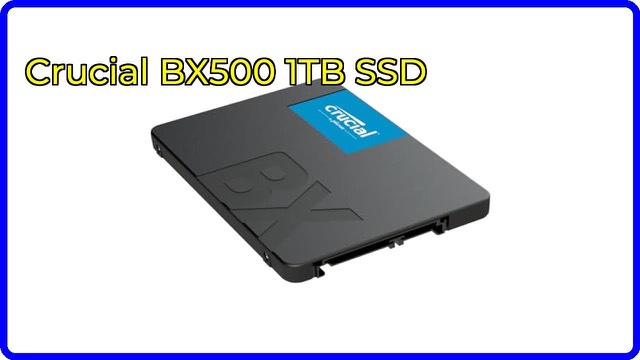
Crucial MX500 1TB 2.5-Inch SATA SSD (CT1000MX500SSD1): specs explained
The Crucial MX500 1TB is a 2.5-inch SATA SSD with 3D NAND, power loss immunity and AES 256-bit encryption. What the speeds and features mean for an upgrade.
This page contains an affiliate link, marked as such. If you buy through it, Bloiq may earn a commission at no extra cost to you.
The Crucial MX500 1TB (model CT1000MX500SSD1) is an internal solid state drive in the standard 2.5-inch SATA format. It is built for upgrading a laptop or desktop that still uses a SATA drive, replacing a mechanical hard disk or adding fast storage for photos, documents and music. Here is what its specs mean.
SATA and the 2.5-inch format
SATA is the long-standing connection used by most hard drives and many SSDs, and the 2.5-inch case fits laptop drive bays and many desktop cases, often with a bracket. SATA has a ceiling of roughly 550-600 MB/s, which is why Crucial's headline figure of up to 560 MB/s is close to what the interface allows. Newer NVMe drives are faster, but they need an M.2 slot, so a SATA SSD remains a practical choice for older machines.
Speeds in everyday use
Crucial lists sequential reads of up to 560 MB/s and writes of up to 510 MB/s, plus random reads of up to 95K and writes of up to 90K (IOPS). Sequential speed matters for copying large files. Random performance matters more for the everyday feel of a computer, such as starting the operating system and opening many small files. Compared with a mechanical hard drive, an SSD typically makes startup and application loading noticeably quicker, as it has no moving parts to wait for.
These are the brand's maximum figures. Real results depend on the rest of the system and the type of data being moved.
3D NAND
Crucial says the drive is accelerated by Micron 3D NAND technology. 3D NAND stacks memory cells in layers, which generally allows more capacity in the same chip area. The listing says the product line stores up to 4TB, with this 1TB model one of the sizes.
Power loss immunity
Integrated Power Loss Immunity is Crucial's term for protection of saved work if power is unexpectedly cut. It is useful for desktops, where a sudden outage is more likely than on a laptop with a battery. It is not a replacement for regular backups.
Hardware encryption
The drive offers AES 256-bit hardware-based encryption. Hardware encryption is handled on the drive itself instead of by the operating system, and it usually has to be enabled through the computer's security settings or compatible software. Check your system's documentation on how to turn it on.
Size, warranty and installation
It measures about 4.1 x 2.8 inches (10.4 x 7.1 cm) and is roughly 0.3 inches (7 mm) thick. Crucial backs it with a five-year limited warranty and says its step-by-step guide walks first-time users through installation. Installing a drive generally involves powering down, unplugging the machine, swapping the drive and then installing the operating system or cloning the old drive.
Who it suits
It suits owners of older laptops and desktops with a SATA bay, as well as people who want a dependable secondary drive for files and media.
What to check before you buy
- Connection: confirm your computer has a 2.5-inch SATA bay, not just an M.2 slot.
- Drive height: check that a drive about 7 mm thick fits your bay.
- Migration: plan how to move your existing system, with cloning software or a fresh install.
- Console or other use: check the device manual if you plan to use it outside a computer.
- Backups: keep a copy of important files elsewhere.
- Encryption: read your computer's guidance before enabling hardware encryption.
The short version
- 1TB, 2.5-inch SATA SSD using Micron 3D NAND.
- Up to 560/510 MB/s sequential read/write; up to 95K/90K random read/write.
- Power Loss Immunity and AES 256-bit hardware encryption.
- Five-year limited warranty from Crucial.
Bloiq is reader-supported. Some links may earn us a commission; it never affects what we write. How we make money.