Home / Tech · Product overviews / Computers & Accessories / Motherboards · More from ASUS
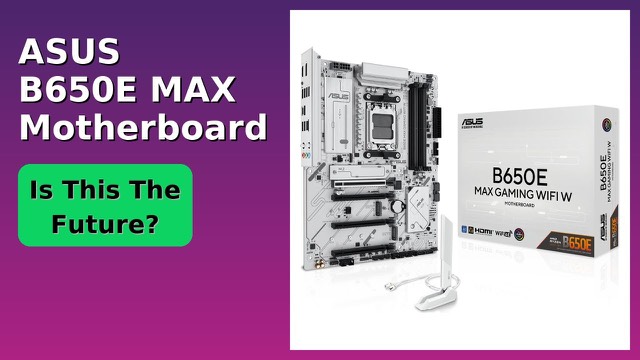
ASUS X870 MAX GAMING WIFI7 W motherboard: features, specs and who it suits
The ASUS X870 MAX GAMING WIFI7 W is a white AM5 ATX motherboard with DDR5, PCIe 5.0, Wi-Fi 7, USB4 and 2.5Gb LAN. What the specs mean and what to check.
This page contains an affiliate link, marked as such. If you buy through it, Bloiq may earn a commission at no extra cost to you.
The ASUS X870 MAX GAMING WIFI7 W is an ATX motherboard for AMD's AM5 socket, finished in white. It's the board that everything else in a desktop PC connects to: the processor, memory, graphics card, storage and network. Here is what its listed features mean for someone planning a build.
Socket, chipset and processors
AM5 is the socket used by AMD Ryzen 9000, 8000 and 7000 Series desktop processors, and ASUS lists all three families as supported. The X870 chipset sits at the upper end of AMD's current range. Check the manufacturer's CPU support list, because some processors need a BIOS update first. The board's BIOS FlashBack feature is there for that: it typically lets you update the firmware from a USB drive without a processor installed.
Power delivery
ASUS lists 12+2+1 power stages rated at 80A each, on an 8-layer PCB, with ProCool connectors, alloy chokes and durable capacitors. Power stages convert the supply's voltage into the lower, steady voltage the processor needs. More and stronger stages generally help hold stable power under heavy load, particularly for high-core-count chips or overclocking. The heatsinks over the voltage regulators help carry that heat away.
Memory, expansion and storage
The board uses DDR5 memory, the current desktop standard on AM5. It has a PCIe 5.0 x16 slot for the graphics card, with the Q-Release feature, which ASUS says makes releasing the card from the slot easier. There are three M.2 slots for solid-state drives, one of them PCIe 5.0, which typically gives the fastest drive speeds available. M.2 and chipset heatsinks are included, and the M.2 heatsink is flexible in design.
Connectivity
- Wi-Fi 7 with the Q-Antenna for easier antenna attachment.
- Realtek 2.5Gb Ethernet for wired networking.
- USB4 (40Gbps) Type-C ports on the rear, plus a front-panel USB 20Gbps Type-C connector.
The listing notes that full Wi-Fi 7 on Windows 11 needs version 24H2 or later. Windows 11 21H2, 22H2 and 23H2 only support Wi-Fi 6E, and Windows 10 supports Wi-Fi 6 only.
Cooling, lighting and software
Hybrid fan headers and Fan Xpert 4 with AI Cooling II manage case and CPU fans. Three Addressable RGB Gen 2 headers connect lighting strips and fans, which can be controlled with Aura Sync. ASUS also supplies Armoury Crate, ASUS AI Advisor, DriverHub and GlideX software. The board is described as CEC Tier II Ready, and ASUS also describes its "ready for advanced AI PC" design aimed at demanding AI applications.
Build-friendly details
The I/O shield is pre-mounted, which saves a fiddly step. The Q-Dashboard and Q-LED Core are aids for checking the build while you assemble it.
Who it suits
It suits people building a new AM5 desktop who want current-generation connectivity, three M.2 slots and a white colour scheme to match a light-themed case.
What to check before you buy
- Processor and BIOS: confirm your CPU is on the support list and whether the board needs a BIOS update for it.
- Memory: it takes DDR5 only, not older DDR4.
- Case: it's a full ATX board, so check your case supports ATX.
- Operating system: Wi-Fi 7 needs a recent Windows 11 version.
- Parts: confirm the manufacturer's memory and storage compatibility lists, and check what ships in the box.
The short version
- White ATX motherboard for AMD AM5 (Ryzen 9000, 8000 and 7000 Series).
- 12+2+1 80A DrMOS power stages on an 8-layer PCB.
- DDR5, a PCIe 5.0 x16 slot and three M.2 slots, one PCIe 5.0.
- Wi-Fi 7, 2.5Gb Ethernet and USB4 (40Gbps) Type-C.
- BIOS FlashBack, Q-Release, Q-Antenna and Aura Sync RGB.
Bloiq is reader-supported. Some links may earn us a commission; it never affects what we write. How we make money.